

Am I Voting Left Because I’m a Woman?
- Jul 30, 2025
- 6 min read
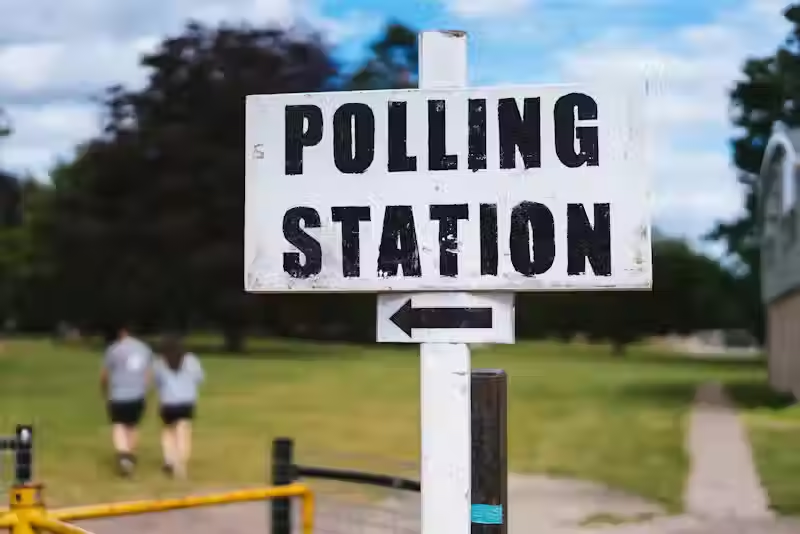
Growing up in an all-girls secondary school, politics wasn’t something we often debated – partly because of our age, but also because there seemed to be an unspoken consensus. Climate change mattered. Feminism wasn’t controversial. Empathy was expected. These weren’t radical views; they were just normal.
Later, stepping into a male-dominated university environment, I began to notice how political those ‘normal’ beliefs really were. Suddenly, the same issues that once seemed like common ground suddenly sparked backlash. Conversations about gender were ‘too woke’ or feminism ‘went too far’ and social justice was something to roll your eyes at.
That shift made me wonder: was my lean to the left really a reflection of my own beliefs? Or was it shaped by the environment I grew up in, surrounded mainly by girls and teachers who framed social issues as common sense? Or was it something more innate – something about being a woman, and focusing on different things to many of the men around me?
After all, men vote left too. But increasingly, young women are swinging further left than their male peers.
Why the divide, and why more dramatically now than ever before? Because despite how things look today, women haven’t always voted this way. And the reasons behind this shift reveal far more than just party preference.
A Historical Flip, From Right to Left:
In the decades following the Second World War, women were more likely to vote for right-wing parties than men. This wasn’t just due to cultural norms. Many women were more religious and less exposed to unionised workforces, which shaped their political identities. Their voting patterns reflected a preference for tradition and security.
But that started to change in the 1980s. What researchers now call the ‘modern gender gap’ emerged, with women, especially younger women, moving steadily left. This wasn’t just a mirror image of earlier trends. It reflected a generational shift in values, shaped by education, feminism, economic independence, and declining religiosity.
Though definitions vary by country, it is generally believed that ‘liberal’ ideologies favour social equity, expanded civil rights and government intervention to address systemic disadvantages. Whereas ‘conservative’ ideologies tend to emphasise tradition, free markets and national identity.
Gen Z and the New Political Divide
Enter Gen Z – a generation raised on the internet, climate anxiety, and the ripple effects of the #MeToo movement. In countries from the US to the UK, South Korea to Canada, women under 30 are now significantly more likely to identify as liberal than their male peers.
In the UK, polling data shows that young women under 25 are nearly twice as likely to vote Labour than young men.
In the US, this divide played out in the 2020 election, where young women overwhelmingly favoured Biden, while young men were more split. In South Korea, the split is even starker: young women rally behind progressive parties, while many young men have swung toward the anti-feminist right.
Is this because women are becoming more liberal, or men more conservative? Likely both. And the reasons are complex.
Symbolic Vs. Operational Ideology
It is worth noting before diving into this topic that on many actual policy issues (from healthcare to housing), men and women often agree more than they disagree. The gender divide tends to show more in values, tone and identity politics rather than in specific economic preferences.
In countries where political discourse is already deeply conservative or tightly controlled, the gender gap is far less visible. That means the division is not universal, but rather it’s shaped by context.
Feminism, Identity Politics and Feeling Left Behind
Movements like #MeToo didn’t just expose gender-based violence – they emboldened young women to claim space in politics, workplaces and public debate. But as feminist politics gained visibility, so too did the backlash.
Some men, particularly those who already felt alienated by economic or cultural shifts, perceived these movements as exclusionary. This resulted in a reactive conservatism, sometimes disguised as ‘anti-woke’ sentiment, often amplified by social media.
Platforms like TikTok and YouTube don’t just reflect opinions but shape them. Algorithms reward extreme, emotionally charged content, which means voices like Andrew Tate’s get disproportionate airtime. These are not representative views, but they get seen, shared, and internalised especially by young, disaffected men.
This dynamic doesn’t just fuel division – it creates eco chambers, with men and women consuming radically different content, shaping differing worldviews.
Education, Secularisation, and Shifting Social Norms
Data helps explain the split. What are the two most consistent predictors of liberal values in Western democracies? Secularism and higher education. Gen Z women outpace men on both.
In both the UK and US, women now spend more years in education than men. University education exposes people to diverse identities, critical thinking, and progressive social norms, all of which correlate with liberal political alignment.
Add to that the fact that young women are now less religious than young men, reversing decades-old trends. Religion once anchored women to conservative parties. Without it, many are more open to redistributive and inclusive politics.
South Korea: Gender-Polarised Politics
In South Korea, the gender divide is now so sharp it’s reshaping the entire political landscape. Traditional gender roles, a highly conservative culture, and mandatory military service for men have contributed to resentment, particularly among men who feel feminism has left them behind. Some parties have openly gone against feminist rhetoric to gain male voters.
The result? Women and men in their 20s now vote for entirely different parties. It’s not just a political divide – it’s a social one. And it’s having knock-on effects on dating, marriage and even birth rates.
What Does This Mean for the Future?
This gendered political divide is subtle in some places and stark in others. But it carries implications far beyond the ballot box.
In countries where men and women live increasingly separate ideological lives, relationships, family formation and even trust can suffer. South Korea’s falling birth rate (now the lowest in the world) has been partly attributed to this widening gender rift.
In more progressive nations like Norway and Sweden, where gender equality is actively promoted in politics and policy, the gap still exists, but it plays out differently. Women may vote left, but men aren’t necessarily pushed right, suggesting that representation and inclusive messaging may buffer polarisation.
Will the Gap Shrink With Age?
Conventional ideas say that people get more conservative with age. But today’s Gen Z women grew up in a radically different world than their grandmothers. Values shaped by education, digital life and feminism don’t just evaporate. In fact, early voting behaviour is often a strong predictor of lifelong political identity.
Still, this isn’t a story of uniform liberalism among women, or inevitable conservatism among men. It’s a movement of identity, information, and systems – of how society responds to progress, and who feels left out in the process.
If politics feels more gendered than ever, it’s because it is. But it’s also because young women are becoming more visible, vocal and values-driven and that, historically, tends to rattle the status quo.
How Important Is Gender In Politics?
Looking back, I don’t think growing up in an all-girls school made me more liberal, but it did mean that empathy, inclusion and fairness were part of the culture. Maybe it was because we weren’t negotiating space with louder voices, or because conversations around things like consent, body image, or equality felt personal rather than political.
At university, in a more mixed environment, I realised how differently people could respond to the same ideas.
That stuck with me, but it also reminded me that gender is just one part of the story. Political identity is influenced by a multitude of factors: class, race, education, religion and even personality traits.
While the gender gap in politics is real (and growing in many places), to reduce it to biology alone misses the deeper, more personal beliefs that shape how people vote. But gender is still a factor - and an influential one. It offers a lens through which many people experience the world, engage with politics, and respond to change.
References
Inglehart, R., & Norris, P. (2003). Rising Tide: Gender Equality and Cultural Change Around the World. Cambridge University Press.
Pew Research Center. (2020). In U.S., Decline of Christianity Continues at Rapid Pace.
Ipsos Mori UK Voting Data (2023). Young Women and Political Participation Report.
Kim, J. & Chungjae, L. (2022). Gender and Youth in South Korea's Politics. East Asia Forum.
London, K. C. (2024, December 6). Gender gap strongest at opposite ends of political spectrum in the 2024 General Election. King’s College London.
McDonnell, A. (2024, July 8). How Britain voted in the 2024 general election. YouGov.
Norris, P. (2025). The Gender Gap: Theoretical Frameworks and New Approaches. Harvard.edu.
Student News Daily. (2005). Conservative vs. Liberal Beliefs. Student News Daily.


Comments